When people talk about what’s holding back Indian exports, the conversation usually goes to tariffs, freight costs, or manufacturing capacity. Rarely does it go to something as unglamorous as bank reconciliation. But for a large share of India’s exporters, that unglamorous back-office process is exactly where growth quietly stalls.
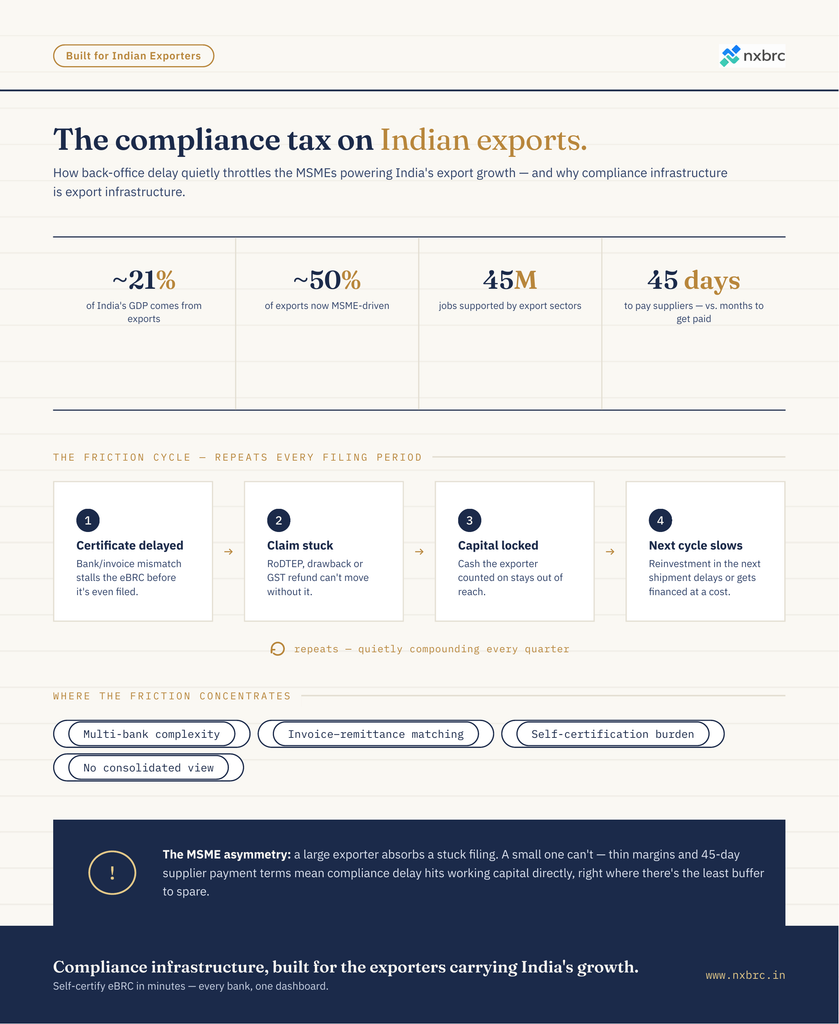
This isn’t a fringe concern. Exports account for close to 21% of India’s GDP and support an estimated 45 million jobs, directly and indirectly. The government’s own Export Promotion Mission — backed by an outlay of roughly ₹25,060 crore through FY 2030-31 — is a clear signal that trade growth is being treated as a national priority, not a side effect of policy. But ambitious targets only translate into real outcomes if the exporters doing the work can operate efficiently. And a growing share of those exporters are small businesses for whom “efficient” is not the default state.
The MSME asymmetry
MSMEs aren’t a minor part of India’s export story — they’re close to becoming the majority of it. Government estimates put MSME-linked exports at nearly half of India’s total exports today, up sharply from a much smaller share just a few years ago. That shift matters, because MSMEs experience compliance friction very differently than large exporters do.
A large exporter can absorb a stuck filing or a delayed refund; it has treasury depth and a compliance team dedicated to catching problems before they escalate. A small exporter usually doesn’t. And the timing mismatch built into export trade makes this worse: MSME exporters typically have to pay their domestic suppliers within 45 days, while their own export proceeds often aren’t realised until goods reach the buyer and payment clears — sometimes months later. Regulatory relief has stretched that window further in recent times, giving exporters more time to receive payment, which helps with payment-cycle disruptions but also means capital can stay locked up longer if paperwork on the exporter’s end isn’t moving in parallel.
Add to this that most MSME exporters operate on thin single-digit-to-low-double-digit margins with little cash buffer, and the picture becomes clear: for this segment, compliance delay isn’t an inconvenience. It’s a direct hit to working capital, at exactly the business size least equipped to absorb it.
Where the friction actually concentrates
None of this is because exporters don’t want to comply — it’s because the process itself is fragmented in ways that scale badly. Three friction points show up again and again:
Multi-bank complexity. Exporters, especially as they grow, rarely bank with just one institution. Remittances land across multiple AD banks and payment gateways, with no consolidated view unless someone builds one manually.
Invoice-to-remittance matching. Every payment received has to be correctly linked to the right invoice or shipping bill. Get this wrong — a mismatched amount, a misreferenced transaction — and the resulting certificate gets rejected or delayed, stalling everything downstream of it.
A structural shift in who owns the work. DGFT’s move toward self-certified eBRCs removed banks as the certifying bottleneck, which was a real improvement in process speed. But it also transferred the accuracy burden onto exporters themselves — right at the moment when many of them have the least spare capacity to absorb new compliance responsibility.
The compounding cycle
The real cost of this friction isn’t visible in any single transaction. It shows up as a cycle that repeats every filing period:
A delayed or mismatched compliance certificate holds up an incentive claim (RoDTEP, duty drawback) or a GST refund. That refund is often capital the exporter was counting on to fund the next production cycle — raw materials, labour, the next shipment. When it’s delayed, the exporter either slows down or borrows to bridge the gap, often at a cost that erodes already-thin margins. Multiply this across thousands of MSME exporters, each losing a little velocity every quarter, and the aggregate effect on India’s export capacity is significant — even though no single instance of it looks like a crisis.
This is precisely the kind of friction policymakers have started to notice. Recent measures — interest subvention on export credit, collateral support schemes, extended repayment and realisation windows — are all, in effect, attempts to soften the working-capital squeeze this cycle creates. They’re valuable. But they treat the symptom. The underlying cause is that the compliance process generating the delay hasn’t scaled down to MSME operating capacity.
Compliance infrastructure as export infrastructure
It’s worth reframing what “compliance software” actually does at an industry level. It’s not just a convenience for the exporter using it — it’s plumbing that determines whether policy incentives translate into real, timely capital in the hands of the businesses they’re meant to help.
A RoDTEP rate cut or a faster GST refund process changes nothing if the certificate it depends on is still stuck in a manual matching queue. The exporters best positioned to benefit from India’s next wave of trade policy will be the ones whose compliance backend can keep pace with it — consolidating remittances across banks automatically, catching mismatches before they become rejections, and turning a self-certification process that used to take days into one that takes minutes.
That’s the layer NXBRC is built for — not as a replacement for the policy push already underway, but as the infrastructure that lets it actually reach the exporters it’s designed for, especially the MSMEs who make up the bulk of India’s export engine and have the least room to absorb friction.
If India’s export targets are going to be hit by the businesses actually doing the exporting — not just the largest players who can afford to weather delays — the back office needs to move as fast as the policy does.
Curious how self-certified, multi-bank eBRC automation could reduce this friction for your export business? Get in touch with us to explore how self-certified eBRC works in practice.