If you export out of India, you’ve almost certainly run into the term eBRC — usually right when you’re trying to close a shipment, claim an incentive, or file a GST refund, and suddenly can’t move forward without one. For a document most exporters only think about a few times a year, it causes a disproportionate amount of friction.
This post covers what an eBRC actually is, how the process has changed in the last few years, and why so many exporters — from established goods manufacturers to first-time software exporters — end up stuck on it.
What an eBRC actually is
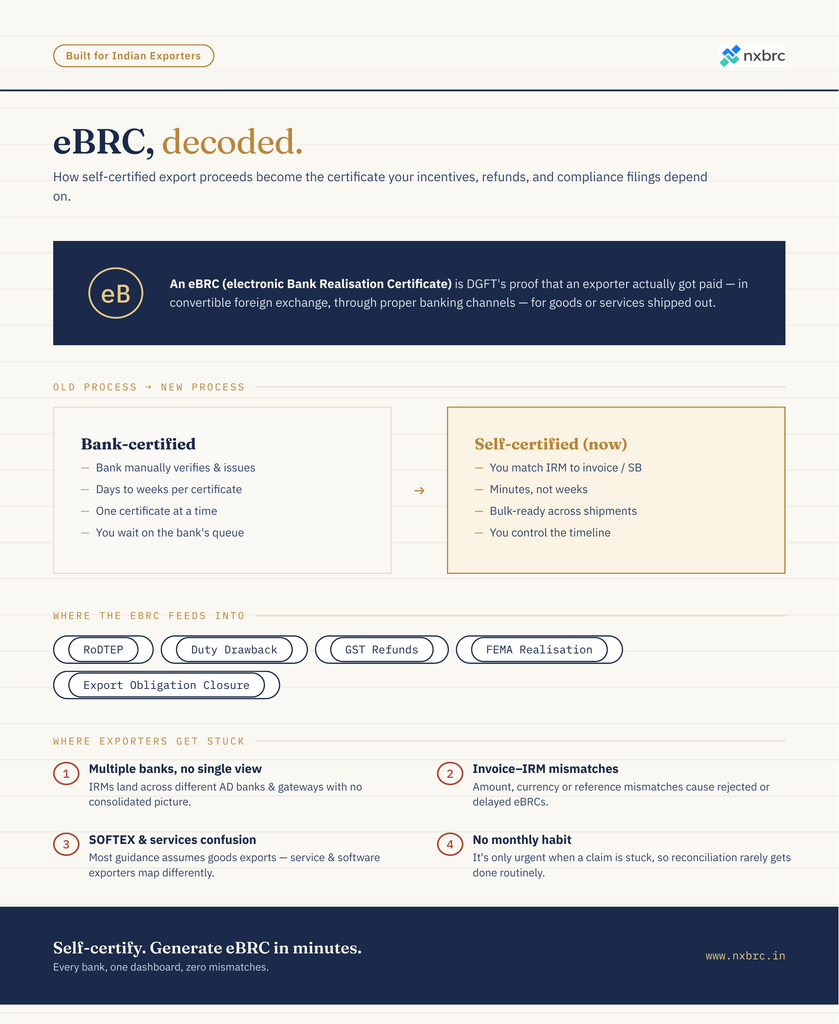
An eBRC, or electronic Bank Realisation Certificate, is your proof that money for an export has actually landed in India through proper banking channels. It’s issued through the DGFT (Directorate General of Foreign Trade) system, and it exists to answer one specific question: did this exporter really get paid, in convertible foreign exchange, for the goods or services they shipped out?
That single fact — proceeds realised — is the backbone of a surprising number of downstream processes:
- Export incentive claims, including RoDTEP and duty drawback
- GST refunds on zero-rated export supplies
- Closing your export obligation on the shipping bill or SOFTEX filing
- RBI/FEMA compliance, since India requires export proceeds to be repatriated within a defined window
Without a clean eBRC, all of these stall. It’s rarely the reason a claim gets rejected outright — but it’s very often the reason a claim gets stuck, sitting in limbo while someone chases down a mismatch.
How the process has changed
For a long time, getting a BRC meant asking your bank to certify it — a manual, bank-mediated process that could take days or weeks per certificate, especially if you worked with more than one banking partner.
That changed with the shift to self-certified eBRCs. Since DGFT’s Trade Notice 33/2023-24, exporters no longer wait on their bank to issue the certificate. Instead, banks upload Inward Remittance Messages (IRMs) — records of foreign exchange received — directly into a DGFT repository, and the exporter self-certifies the eBRC by linking those IRMs to the correct invoices or shipping bills. DGFT has continued refining this system since, including further process enhancements under Trade Notice 12/2024-25 and additional fields for services exports introduced via Trade Notice 02/2025-26.
This was a genuine improvement: it removed the bank as a bottleneck and put control back in the exporter’s hands. But it also quietly shifted the compliance burden. Under the old system, the bank did the certifying. Under the new system, you do — including the responsibility of getting the invoice-to-IRM mapping right. That single change is the root of most of the pain exporters now describe.
Why exporters still get stuck
Self-certification is faster in theory, but it introduces a matching problem that used to be someone else’s job. A few patterns show up constantly:
Multiple banks, no single view. Most exporters — especially anyone doing more than a token volume — don’t route every remittance through one bank. Between AD banks, payment gateways, and legacy banking relationships, IRMs land in different places, and there’s no unified view unless you build one yourself.
Invoice-IRM mismatches. An IRM might reference a slightly different amount, currency, or reference number than the invoice it’s meant to correspond to. On the DGFT portal, catching this before submission is a manual, invoice-by-invoice exercise — and it’s exactly where rejected or delayed eBRCs come from.
SOFTEX and services confusion. Most eBRC guidance online is written with goods exporters in mind — shipping bills, HS codes, customs. Software and IT/ITeS exporters work through SOFTEX filings instead, and the purpose codes, mapping rules, and documentation expectations differ just enough to trip people up.
No urgency until it’s urgent. Because eBRC only becomes a blocker at the moment you need it — filing a claim, closing a GST refund — most teams don’t build a disciplined monthly habit around it. It becomes a scramble instead of a routine.
The real cost isn’t the certificate — it’s the delay
It’s worth being precise about what eBRC problems actually cost an exporter. It’s rarely that a claim gets rejected forever. It’s that:
- Cash tied up in a GST refund or incentive claim sits stuck for longer than it needs to
- Finance teams spend recurring hours every month on reconciliation that adds no strategic value
- Errors compound — a small mismatch this quarter becomes a harder one to unwind next quarter
None of this shows up as a single dramatic event. It shows up as a slow tax on operational time and working capital, quarter after quarter.
Where this is heading
DGFT’s direction over the last few Trade Notices has been consistent: more self-service, more system-level validation, tighter integration with GSTN, ICEGATE, and RBI’s export monitoring framework. That’s a good thing for exporters — but it also means the tools and habits you build around eBRC matter more than they used to, not less. Self-certification only pays off if the certifying itself is accurate and low-effort.
That’s the gap platforms like NXBRC are built to close — consolidating remittances across every bank you work with, catching invoice-IRM mismatches before they become rejected filings, and making self-certification something your team does in minutes, not something they dread every month-end.
Have questions about how this applies to your specific export flow ? Get in touch with us to explore how self-certified eBRC works in practice.